
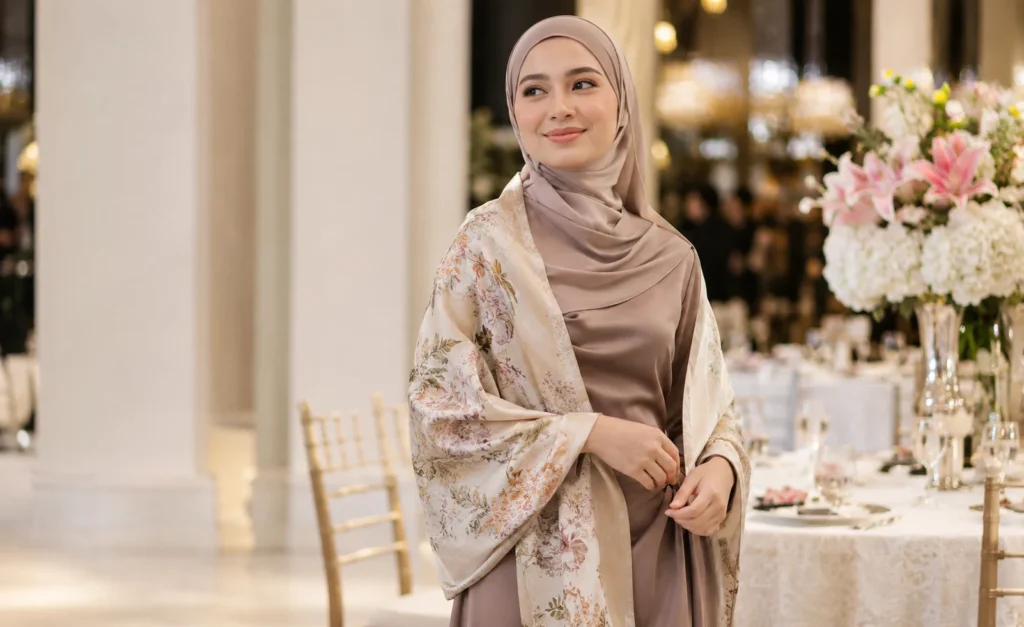
The easiest way to wear a shawl over a dress is to drape it across the back of your shoulders with both ends falling evenly in front. For a sleeveless dress, choose a shawl at least 170 cm long and about 65 cm wide, so it covers your shoulders and upper arms without a pin.
At Malaysian weddings, colour matters as much as the drape. White and black are best avoided at Chinese and Indian weddings, and red usually belongs to the bride. Malay weddings care less about colour and more about modest coverage.
Air conditioning is the first reason. Hotel ballrooms and restaurants run it hard, and a sleeveless dress that feels right outside can feel cold an hour into dinner.
Coverage is the second. Indian wedding ceremonies expect guests to avoid bare shoulders and low necklines, and Malay weddings call for modest dress too. With a shawl, one dress can take you from a covered ceremony to a relaxed evening reception.
Width decides how much of your arms are covered, and length decides how many ways you can drape it. Our shawls come in these sizes:
| Shawl size | What it covers |
|---|---|
|
110 x 55 cm and 150 x 55 cm
|
A light layer across the shoulders, with arms mostly bare
|
|
66 x 170 cm and 71 x 175 cm
|
Shoulders and upper arms, the safe choice for most dresses
|
|
75 x 195 cm, and silk shawls up to about 205 cm
|
Enough length to cross over the chest or wrap fully in a cold room
|
If you need your arms covered for a ceremony, go for a shawl 66 cm wide or more. You can filter shawls by size in our shop.
All five work with a long rectangular shawl. Practise once in front of a mirror before the event, since a drape that looks easy can take a few tries to sit evenly.
Hold the shawl behind you at both ends, rest it across the back of your shoulders, and let the ends fall evenly down the front. It suits almost any dress and is the quickest to put on or take off between ceremony and reception.
Start with the open drape, then lift one end and throw it over the opposite shoulder so it hangs down your back. Pin it at the shoulder with a small brooch if the fabric is slippery. This one looks particularly good at evening receptions.
Drape the shawl open, then cross the two ends over your chest and pin them at one side, near the waist. It covers a low neckline completely, which makes it the best drape for a religious ceremony.
Drape the shawl open and let the ends hang straight down the front. Put a thin belt on over the shawl at your waist. The belt holds everything in place while you eat, and it gives a loose dress a defined shape.
Let the shawl slip down your back until it rests in the crook of your elbows, leaving your shoulders bare. Use it at dinners and receptions where coverage is not expected. It photographs beautifully, but it will not keep you warm.
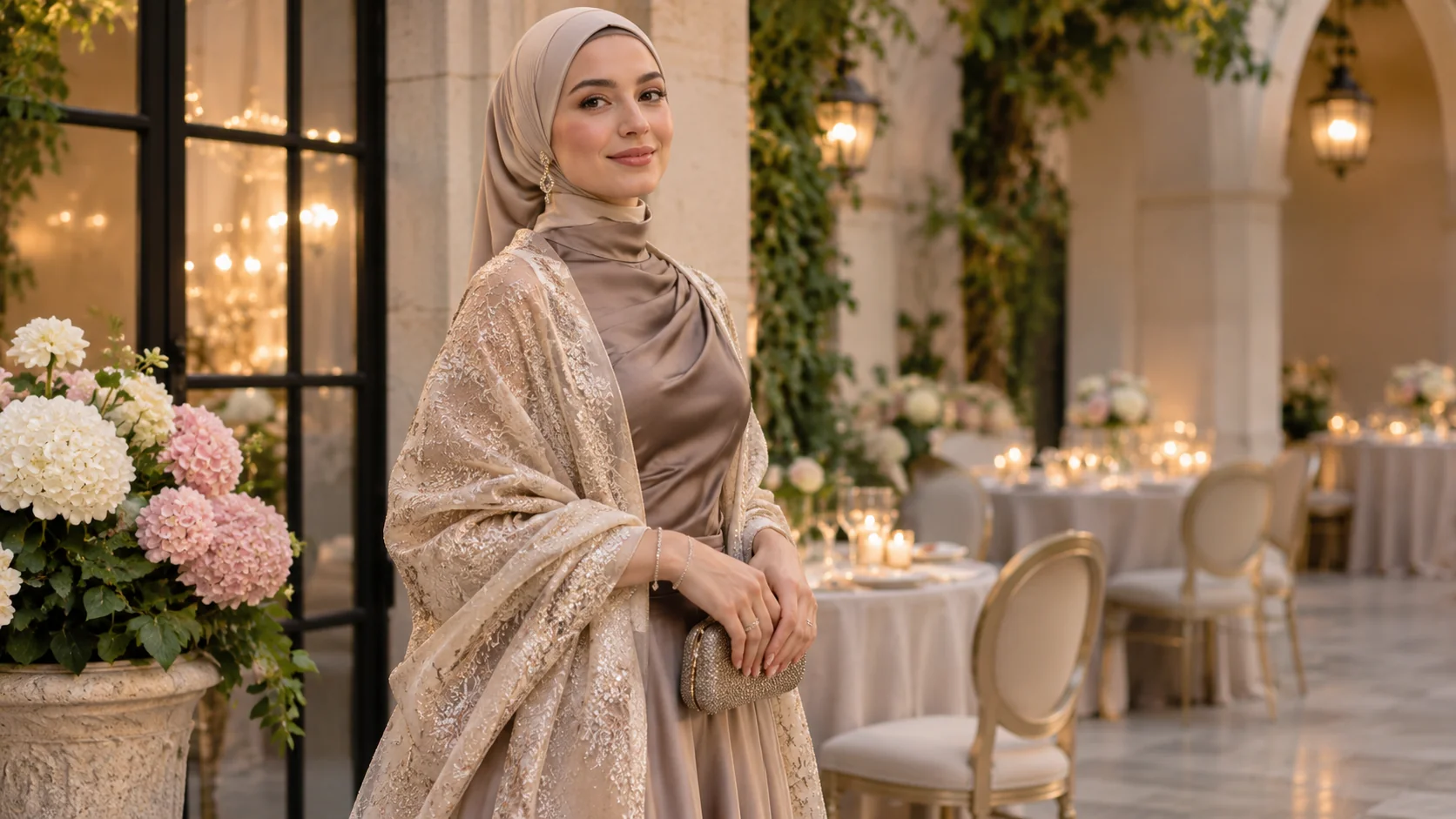
Strapless and off-shoulder dresses look best with the classic open drape or the low elbow drape, which keep the neckline visible. For a ceremony, the crossed-and-pinned drape covers them fully.
With a halter or one-shoulder dress, throw the shawl over the bare shoulder so the two sides balance. A high-neck dress needs no coverage, so wear the shawl purely for warmth in the open drape.
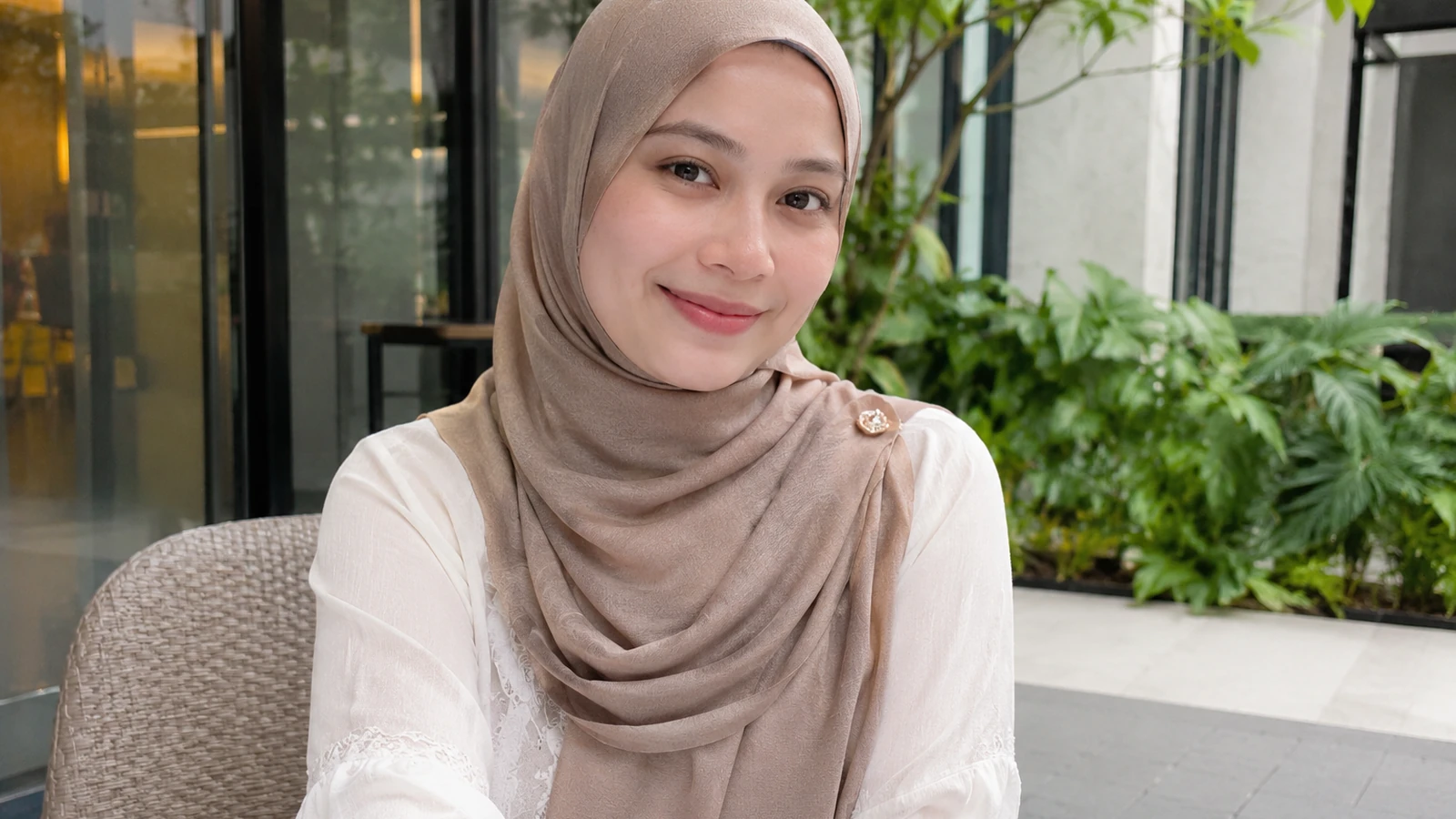
You may not need a second piece at all. Many women wear a long shawl as their tudung and let one end fall over the opposite shoulder, which covers the neckline of the dress at the same time. Our guide to 5 ways to tie a Turkish shawl shows how.
If you wear your tudung and the dress in different colours, pick the tudung colour out of the dress print rather than trying to match it exactly. One shade lighter or darker looks deliberate.
Malaysia’s wedding customs differ by community, so the safe colour depends on whose wedding it is.
Avoid a white or black shawl, since both are linked to mourning in Chinese culture. Skip red too, as it is traditionally the bride’s colour. Brighter shades like green, pink or a jewel tone are the safe choices.
White and black are also best avoided, and red is often worn by the bride. For the ceremony, choose a shawl wide enough to cover your shoulders. At the evening reception you can be far more colourful.
There are no colour taboos at a Malay wedding, so focus on modest coverage and follow any theme printed on the invitation. Many brides wear white for the akad nikah, so a fully white outfit is better avoided.
Away from weddings, a black shawl or a white shawl is a classic choice over an evening dress. A gold or silver shawl works well at a gala or a Raya open house.
At a wedding, though, an all-metallic shawl can look bridal. A print with touches of gold is safer.
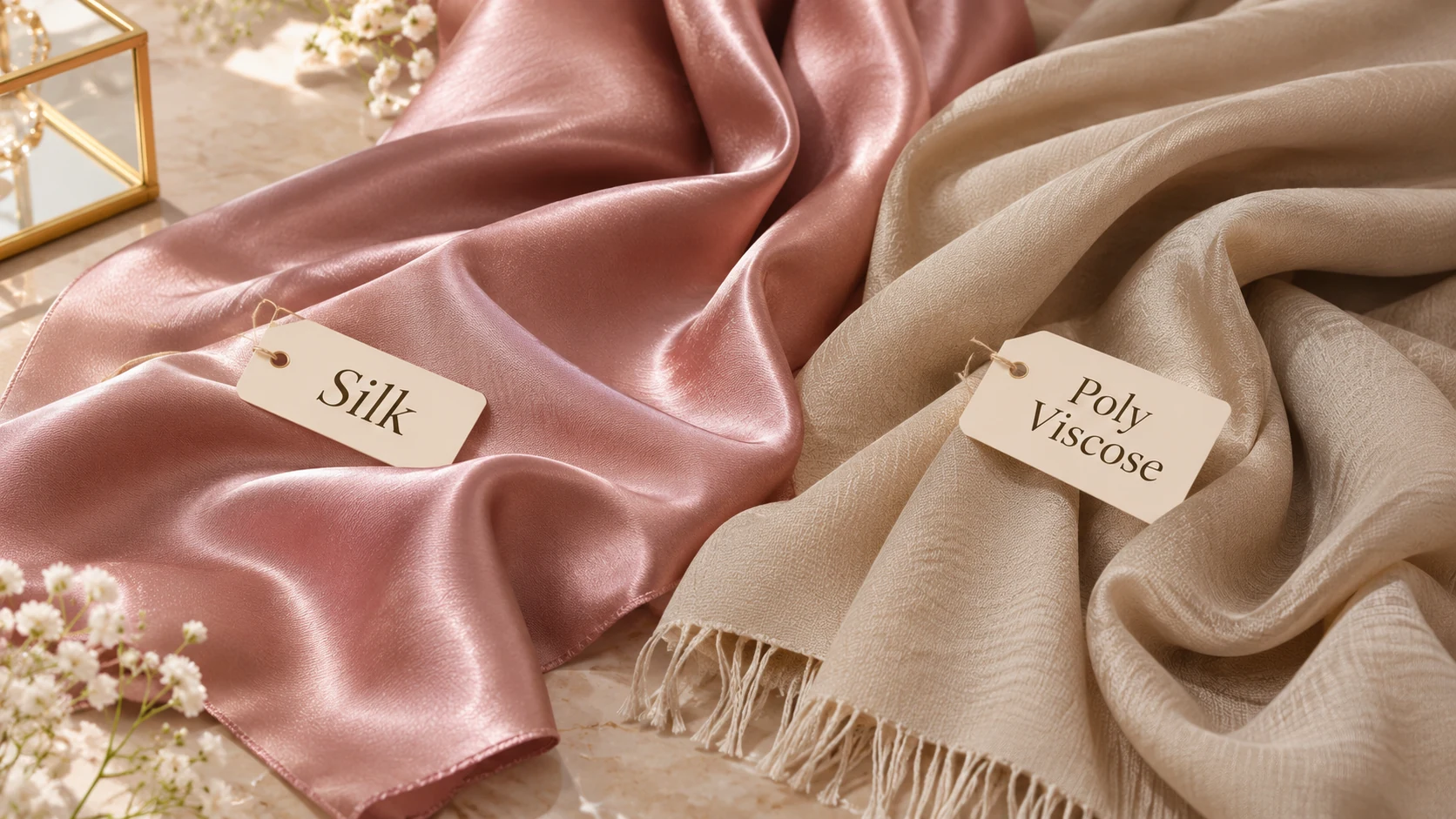
Silk gives the most fluid drape and a soft sheen, which makes a silk shawl ideal for indoor receptions. Our Khadija Green Twill Silk Shawl, at 198 x 68 cm, is long enough for every drape in this guide. Silk does show water and sweat marks, so it suits air-conditioned venues best.
Poly viscose is the practical choice for long or outdoor events. The viscose gives softness and drape, while the polyester adds body and resists creasing. Our Kehribar Shawl (75 x 195 cm) and Sultan Shawl are both poly viscose.
A small brooch or two fine pins at the back of one shoulder will hold most drapes. On silk, fasten the brooch through a folded double layer so its weight does not pull a single thread.
If the shawl keeps sliding, switch to the belted wrap or the crossed-and-pinned drape. Poly viscose also grips the shoulders better than silk.
Order at least two weeks ahead. Orders are packed within 1 to 5 working days, then take 2 to 4 working days to reach Peninsular Malaysia and 4 to 7 to Sabah and Sarawak, as our shipping and payment page explains. Check the colour in daylight when the parcel arrives, since screens show colour differently.
If anything is damaged or wrong, you have 7 days from delivery to tell us under our returns policy. After the event, air the shawl out and check the edges for makeup before folding it away. Our guide on how to wash and store a silk scarf covers silk care in full.