
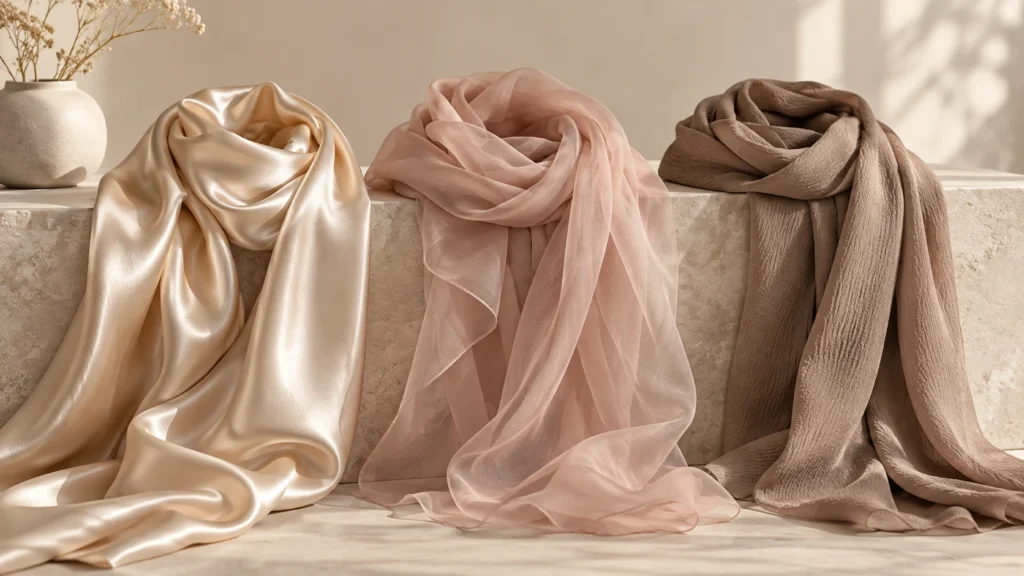
The fastest way to tell them apart: silk has a natural sheen and a fluid, almost liquid drape, chiffon is sheer and airy enough that most people wear it over an undercap, and crepe has a subtly textured, matte surface that holds its shape and stays put better than either of the other two. Each suits a different kind of day, and the rest of this guide breaks down exactly where they differ.
Silk drapes more fluidly than chiffon or crepe and has a natural sheen that shifts gently with light. It’s opaque enough on its own that most people don’t need an undercap for coverage, though many still wear one to help it grip. It’s also the most delicate of the three and the most expensive, since it’s a natural protein fibre rather than a processed or synthetic one.
Chiffon is the sheerest of the three, light enough that most people layer it over an undercap for coverage and grip. It wrinkles a moderate amount, more than crepe, less dramatically than a very lightweight silk, but it shakes out easily and doesn’t need much ironing for everyday wear. Its lightness makes it one of the most breathable options for Malaysia’s daily humidity.
Crepe has a subtly pebbled or crinkled surface, created by how the yarns are twisted before weaving, which gives it more grip and less slip than chiffon or silk. Most crepe used for scarves has a small amount of natural give from that texture, though it isn’t stretchy in the way knit fabric is, it simply has slightly more flexibility than a flat weave.
It’s also more opaque than chiffon, so it rarely needs an undercap for coverage alone, and it holds pleats and structured wraps noticeably better than the other two.
Crepe isn’t a single fibre; it’s a weave defined by tightly twisted yarns that create that signature crinkled surface. It can be made from silk, polyester, rayon, or blends, which is why two crepe scarves can feel quite different depending on what they’re made from.
When Benang lists a piece as crepe, the texture and structure described here apply, and the fibre content is listed separately on the product page.
| Attribute | Cotton | Rayon | Crepe |
|---|---|---|---|
|
Sheerness |
Opaque, natural sheen |
Sheer, needs an undercap
|
Mostly opaque, matte
|
|
Drape |
Fluid, pools softly |
Very light and floaty
|
Structured, holds shape
|
|
Texture |
Smooth |
Smooth but airy
|
Subtly pebbled/crinkled
|
|
Grip/Slip
|
Can be slippery
|
Moderate slip
|
Low slip, stays put
|
|
Best for
|
Occasions, gifting
|
Daily humid wear
|
Structured, styled looks |
If the label is missing or you’re comparing pieces in person, three quick checks help. Hold the fabric up to a light source: chiffon lets noticeable light through, crepe and silk mostly block it. Scrunch a section in your hand: crepe holds a slightly textured, crinkled feel as it relaxes, while chiffon and silk fall smooth and flat again almost immediately.
Rub two layers together: crepe grips and resists sliding, chiffon and silk both slip more easily against themselves, which is part of why crepe holds a wrap in place better through a long day.
All three benefit from a gentle approach, but they’re not identical. Silk is the most sensitive to sunlight and heat, so it needs cool water, mild detergent, and shade to dry. Chiffon tolerates a slightly firmer hand wash and dries quickly thanks to how light it is, though it should still avoid a hot dryer.
Crepe is the most forgiving of the three day to day, its texture hides minor creasing well, but it still prefers air drying over machine heat to keep its crinkled surface from flattening out over time.
Georgette looks similar to chiffon at a glance, both are lightweight and semi-sheer, but georgette has a slightly heavier weight and a more pronounced crinkled texture, which makes it a little more opaque and a little more structured than chiffon.
If a chiffon scarf feels unexpectedly grippy or slightly textured rather than perfectly smooth, there’s a good chance it’s actually georgette or a chiffon-georgette blend.
For daily wear where breathability matters most, chiffon is the lightest and coolest option. If you want something that holds a structured style and won’t slip around as much through a humid day, crepe is the more practical pick. And if you’re after the most fluid drape and a bit of everyday luxury, silk is worth the extra care it needs.